
Help us monitor and protect the Caribbean Flamingo.
We study the Caribbean Flamingo (Phoenicopterus ruber) through long-term research to support its conservation.
Flamenco Lab generates and analyzes data on survival, regional movements, and threats to inform evidence-based conservation decisions.
From the Yucatán Peninsula to Florida, Cuba, and across the Caribbean, we connect field records with applied science.
Every band tells a story.
Science turns it into conservation.
What do we do?
Tracking banded individuals
We monitor flamingos marked with coded bands to understand:
-
Movements between wetlands
-
Use of critical habitats
-
Connectivity across Caribbean subpopulations
-
Survival in the wild
Long-term studies transform isolated records into strategic knowledge for regional conservation.
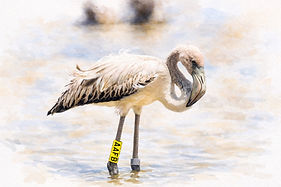

Affected Flamingo Observatory (OFA)
The OFA documents and analyzes:
-
Non-natural mortality
-
Injuries associated with infrastructure
-
Attacks by domestic animals
-
Habitat loss and pollution
-
Emerging threats
Identifying spatial risk patterns helps guide preventive actions and management decisions.

The importance of medium and long-term studies
The Caribbean Flamingo is a long-lived and highly mobile species
Without continuous monitoring over time, it is impossible to detect population changes or emerging threats.
Continuity in knowledge is essential for effective conservation.
Every validated record contributes to a better understanding of regional population dynamics.
Flamingos do not recognize borders.
Conservation shouldn't either.
Participate in monitoring


Report banded flamingos.
Your observation is key to strengthening long-term studies.
01
Observe flamingos.
03
Record the band code.
05
Receive your certificate!
Timely information helps identify critical risk areas, document threats and strengthen prevention efforts.
02
Photograph the band (if possible) - Please try to get a photo of the band from a side view so the letters can be read.
04
Submit date and location.


Become a FlamencoLab ally
Bands tell stories that cross borders. Science turns those stories into conservation action.
Your support strengthens the long-term monitoring of the Caribbean Flamingo and turns sightings of banded birds and reports of injured or dead flamingos into scientific evidence that helps protect the species and the wetlands it depends on.

Bands Reveal a Connected Caribbean
Resighting records of flamingos banded in Yucatán, documented by institutions, researchers, and collaborators, have revealed movements to Florida, Cuba, Texas,
Louisiana, and other locations beyond the northern Yucatán Peninsula.
These records demonstrate the population’s regional connectivity and the need to share information and coordinate conservation efforts across borders.
According to a press release issued by Mexico’s National Commission of Natural Protected Areas (CONANP)*, 154,446 Caribbean Flamingo chicks hatched between 1999 and 2024, of which 7,142 were banded through a collaborative effort involving protected areas, local communities, academic institutions, civil society organizations, and the private sector.
This long-term, collaborative work has generated an exceptional body of information for studying the species’ survival, movements, and use of coastal wetlands.
FlamencoLab contributes by compiling, verifying, and analyzing resighting records, turning individual observations into information that supports conservation.
Banded flamingos.
(Period: 1999 - 2024)
7,142
Most frequently recorded cohorts.
(Aug. 2025 - Aug. 2026)
2014 & 2016
Longest documented lifespan.
(Aug. 2025 - Aug. 2026)
30 years
International connectivity.
(Aug. 2025 - Aug. 2026)
Florida, Cuba
Share their space responsibly
Every visit can contribute to conservation — or take away from it.
The Caribbean flamingo inhabits fragile wetlands that also serve as spaces for recreation and tourism.
Observers, kitesurfers, and visitors all have an active role in protecting them: knowing how to behave near the colonies makes the difference between a harmless presence and a real disturbance.
Here you'll find practical guides for enjoying these spaces without compromising the wellbeing of the birds.


